
A spiritual centre
The Temple
Not a complex of five temples — one sacred hall where the five Kailash Shivlings are to be consecrated.
Temple Introduction
Not everyone can reach Kailash.
Age, health, financial circumstances, geographical distance, and various challenges of life may become obstacles. However, this does not mean that Shri Panch Kailash Mandir claims to be a “substitute” for these sacred pilgrimage sites. Making such a claim would not be appropriate.
The vision of Shri Panch Kailash Mandir is founded on the sacred principle of “One Temple — One Main Assembly Hall (Sabha Mandap) — Five Sacred Shivlings — One Divine Shiva Family.”
Our resolve is far more modest.
The actual Kailash is sacred in its own right. Journeys to it are, in their own way, unique.
However, the vision is to offer devotees who hold deep reverence for these five sacred Kailash abodes an opportunity to worship Lord Sadashiva in one sacred temple, where each Kailash is represented by a natural Shivling. Through these Shivlings, devotees may experience a spiritual connection with the sacred memories, divine essence, and symbolic spiritual energy of each Kailash, while engaging in heartfelt worship of Lord Sadashiva.
The Vision of the Temple
Direct Darshan of the Divine Shiva Family from the Main Entrance
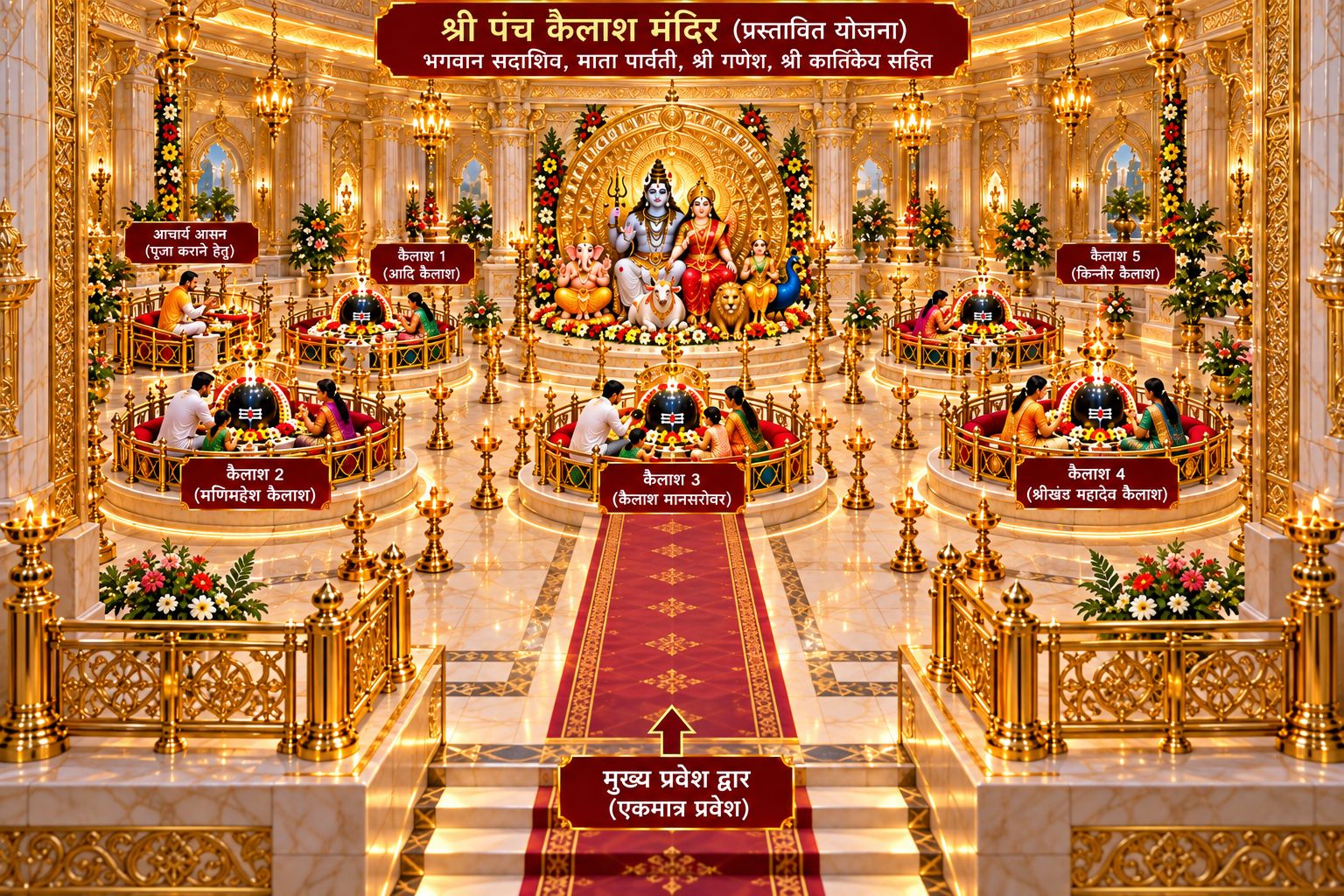
The central Darshan pathway will remain open, with all five sacred Shivlings arranged on either side in a crescent-shaped or balanced worship layout. Each Shivling will have its own dedicated worship area (Puja Mandal), allowing families to sit together and perform Puja and Abhishek (sacred ritual bathing) independently.
- All five sacred Shivlings will be housed within a single main assembly hall (Sabha Mandap) — there will not be five separate temples for them.
- Each Shivling will have a dedicated space in front of it, allowing families to perform Puja and Abhishek (sacred ritual bathing) together.
- Along the central and principal Darshan axis of all five Shivlings will be the divine Shiva Family, comprising Lord Sadashiva, Goddess Parvati, Lord Ganesha, and Lord Kartikeya.
॥ Divine Shiva Family and Panchdev Consecration ॥
Shivdham, dedicated to the worship of Sadashiva
The central Divine Shiva Family will feature the sacred forms of Lord Sadashiva, Goddess Parvati, Lord Ganesha, and Lord Kartikeya. In addition, the temple’s religious vision includes the proposed Panchdev Pratishtha (Consecration of the Five Deities) — the ceremonial installation of the divine idols of Lord Shiva, Lord Ganesha, Lord Surya (Sun God), Lord Lakshmi-Narayana, and Goddess Durga through the sacred rituals of Pran Pratishtha (Divine Consecration).
The Shiva Family and Their Traditional Mounts
It provides an opportunity for reflection on the balance between austerity, strength, motherhood, auspiciousness, courage, discipline, and the responsibilities of household life.
Panchdev Consecration (Proposed)
The five Shiva Lingas, associated with the five Kailash sites, will serve as the temple’s distinct spiritual hallmark; the Panchadeva (five-deity) arrangement will embody the comprehensive synthesis inherent in Sanatana worship.
The final consecration rituals Pratishtha-Vidhi and the overall layout will be determined under the guidance of a Pratishtha-acharya or a qualified religious scholar.
॥ From Muktinath to the Sacred Abode of Lord Shiva — The Divine Journey of Three Shaligram Stones ॥
Three Sacred Shaligram Stones from Muktinath–Gandaki
In June 2026, the revered saint undertook a sacred pilgrimage to Muktinath Dham in Nepal and brought three sacred Shaligram stones from the Gandaki River for Shri Panch Kailash Mandir. It is our sacred resolve to consecrate these three Shaligrams near Lord Lakshmi-Narayana for worship.
Some sacred memories are preserved in photographs — while others become an integral part of divine worship itself.
Muktinath-Gandaki Shaligram 1
Muktinath Dham • Gandak River • Nepal
Proposed ConsecrationMuktinath-Gandaki Shaligram 2
Muktinath Dham • Gandak River • Nepal
Proposed ConsecrationMuktinath-Gandaki Shaligram 3
Muktinath Dham • Gandak River • Nepal
Proposed Consecrationपाँच शिवलिंग
Five Shivlings Do Not Represent Five Different Gods
The Supreme Deity of worship is one and the same — Lord Sadashiva. Each Shivling is intended to be consecrated under the name of its respective Kailash, preserving the sacred memory and spiritual significance of that pilgrimage.
॥ Why are there five Shiva lingas in the Panch Kailash temple? ॥
The fundamental vision of Shri Panch Kailash Mandir is rooted in five sacred pilgrimages to the actual Kailash sites. There are five Kailash pilgrimage destinations, and the sacred resolve is to obtain one natural Shivling from each Kailash, bringing together a total of five Shivlings for their eventual consecration in the temple, in accordance with the divine will of Lord Shiva.
Puja and anointment system
Participatory Worship
The temple’s vision is centered on participatory worship and devotion. Dedicated worship areas (Puja Mandals) will be developed around each Shivling, allowing families to sit together and reverently perform Puja and Abhishek (sacred ritual bathing).
Family-based worship
Seated Worship Facilities at Every Puja Mandal
Coronation
Abhishekam performed by the family in front of each Shiva Linga.
Guidance from the Acharya
Acharya Asana — for the person conducting the worship.
Unobstructed view
The main viewing axis always remains open.
Somasutra and Sacred Abhishek-Water
Respectful and Sacred Flow of Abhishek Water
Priority will be given to ensuring that the dedicated Abhishek water drainage channel does not pass beneath areas where devotees walk, sit, or perform worship. It will remain completely separate from sewage and toilet wastewater drainage systems.
Shivling
Jalhari
Somasutra
Protected Collection
Non-Walkable Sacred Service Zone
External Collection
The religious review (consecration, use of sacred pilgrimage water, Somasutra, Puja, and Abhishek) and the final architectural and MEP drawings will be published after proper verification and approval.
Proposed 3D design
Conceptual Design
Exterior View, Main Entrance, Assembly Hall (Sabha Mandap), Divine Shiva Family, Five Worship Mandals, Family Abhishek Arrangements, Crescent-Shaped Circulation Layout, Sacred Water Management System, and Night View — all visuals will be added as they become available, with each clearly labeled “Conceptual Design.”
Conceptual Design
Shiva Family
At the centre are Lord Sadashiva and Goddess Parvati, accompanied by Lord Ganesha and Lord Kartikeya. Their traditional vehicles include Nandi, the lion, the mouse and the peacock. Direct darshan is available from the main entrance.
Text Alternative for 3D Content
Spiritual View
- Shiva Family — At the centre are Lord Sadashiva and Goddess Parvati, accompanied by Lord Ganesha and Lord Kartikeya. Their traditional vehicles include Nandi, the lion, the mouse and the peacock. Direct darshan is available from the main entrance.
- Kailash Mansarovar — Shiva Tattva — The proposed worship mandal for the Kailash Mansarovar Shivling is positioned along the central darshan axis.
- Manimahesh — Surrender — A dedicated worship mandal for the Manimahesh Kailash Shivling, allowing families to sit together for worship and Abhishek.
- Adi Kailash — Spiritual Practice — The proposed worship mandal for the Adi Kailash Shivling, associated with an upcoming pilgrimage chapter.
- Shrikhand Kailash — Austerity — The proposed worship mandal for the Shrikhand Kailash Shivling, associated with an upcoming pilgrimage chapter.
- Kinnaur Kailash — Devotion — The proposed worship mandal for the Kinnaur Kailash Shivling, associated with an upcoming pilgrimage chapter.
Architecture View
- Main Entrance — The single main entrance provides a direct and unobstructed view of the Shiva Family.
- Central Darshan Path — The central axis will remain open, ensuring that no structure obstructs the direct line of darshan.
- Crescent-Shaped Circulation — The five Shivlings are arranged in a balanced, crescent-shaped worship layout on both sides, allowing devotees to perform circumambulation without overcrowding.
- Acharya Seating — A designated seat for the Acharya to guide family worship and Abhishek rituals.
- One Sacred Assembly Hall — Not five separate temples, but one divine assembly hall under a single roof.
Sacred Water View
- Shivling → Jalahari — The first design priority is to ensure the safe flow of Abhishek water from the Shivling and its Jalahari.
- Somasutra — The Somasutra carries water from the Jalahari in a traditionally appropriate direction. Its final configuration will be determined by the consecration Acharya and architectural experts.
- Protected Water Collection — Protected collection of Abhishek water, with priority given to avoiding drainage routes beneath regular walking, seating or worship areas.
- Non-Walkable Sacred Service Zone — A separate, non-walkable sacred service zone for Abhishek water, completely isolated from sewage and toilet drainage.
- External Water Collection — The final stage involves external collection for the responsible management of sacred Abhishek water.
One roof — one assembly hall — one abode of Shiva — five Kailash peaks.
Join this Initiative →